Christmas Bauble Card with Fold Art Review
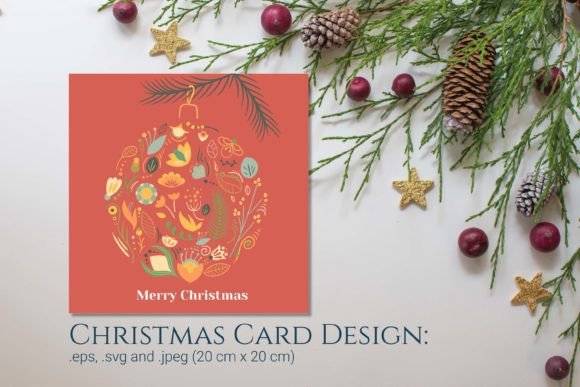
When I first opened the Christmas Bauble Card with Fold Art files, my immediate thought was not just about the aesthetic appeal, but about how this vector illustration would translate into physical thread. As a designer who bridges the gap between digital graphics and machine embroidery design, I look at illustrations differently than a print designer does. I am looking for stitch paths, density issues, and structural integrity. This specific design, featuring folk art elements arranged in a bauble shape with a clever fold effect, presents a unique opportunity for holiday embroidery projects, but it also demands careful planning before you hoop your first piece of fabric.
Translating Folk Art Vectors to Stitch Logic
The Christmas Bauble Card with Fold Art is categorized under Illustrations and Graphics, which tells me immediately that this is originally a vector asset (.svg and .eps) rather than a pre-digitized embroidery file. For an Etsy seller or small shop product creator, this is actually an advantage. The ability to move elements in Adobe Illustrator means you can customize the layout before digitizing. However, folk art is notorious for intricate details that look beautiful on screen but can become a muddy mess under a needle if not handled correctly.
In my evaluation, the "fold art" aspect creates a sense of depth and dimension. Visually, it mimics a paper card standing up or unfolding. In an embroidery project, replicating this requires strategic use of stitch types. You cannot simply apply a flat fill stitch and expect the same impact. To make this work as a sweatshirt embroidery or tote bag design, I would recommend treating the fold lines as distinct boundaries. Using a satin stitch border to define the fold against a fill stitch background can create that necessary separation. If you are creating an applique design version, the fold line serves as the perfect placement guide for fabric layers, adding actual tactile depth rather than just visual illusion.
Real-World Application: The Holiday Tote Bag Test
To truly judge the viability of this design, I mentally applied it to a real-life scenario: a custom embroidered tote bag intended as a personalized gift or boutique merchandise. Canvas tote bags are a staple for craft business owners during the holiday season because they are practical and offer a great surface area for detailed graphics.
The bauble shape is naturally self-contained, which makes it an excellent candidate for center-chest placement on apparel or the center panel of a bag. However, the folk art elements inside the bauble likely contain varying line weights. When stitching this onto canvas, the texture of the fabric will compete with the design. My professional advice is to avoid tiny running stitches for the internal folk details. Instead, scale the design up so that every element has enough width to support a proper column stitch or textured fill. If the bauble is too small, those charming folk details will disappear into the weave of the canvas. For a finished product that feels high-end and professional, clarity always beats complexity.
Navigating Fabric Challenges and Hoop Sizes
While the Christmas Bauble Card with Fold Art is versatile, there are specific environments where I would urge caution. The "fold" concept relies on clean lines and contrast. On dark fabrics, achieving this without excessive underlay or color changes can be difficult. If you are planning baby embroidery on a dark onesie, ensure the stabilizer is robust enough to prevent puckering around the dense areas of the bauble, yet light enough not to weigh down the garment.
Stretchy fabrics like jersey knits used in t-shirts present another challenge. The geometric nature of a bauble combined with organic folk art requires stable registration. If your hoop size is tight against the design perimeter, you risk distortion. Always leave adequate margin. Furthermore, if you intend to use this for commercial embroidery on caps, be aware that curved surfaces distort vertical symmetry. The fold art effect might look skewed on a hat front unless you specifically digitize or adjust the vector to compensate for the cap's curve. In such cases, simplifying the bottom half of the bauble often yields better results than forcing the full illustration onto a limited stitch area.
Elevating Product Value Through Design Integrity
For creative entrepreneurs and handmade shop owners, the value of your merchandise is directly tied to the execution of your design assets. A customer buying a holiday gift expects crisp edges and vibrant thread colors, not a design that looks pixelated or thread-bare. The Christmas Bauble Card with Fold Art has strong potential to increase buyer engagement because of its nostalgic, handcrafted mood. Folk art resonates deeply with customers looking for traditional holiday aesthetics.
However, professionalism comes from testing. Before listing any item featuring this design, create a printable mockup to visualize scale, but more importantly, stitch a physical sample. Check the stitch density in the fold areas. Is the transition smooth? Does the fabric tunnel? These technical checks build customer trust. When a buyer sees that the embroidered patch or pillow cover maintains its shape after handling, they recognize the quality of the maker. This design’s intricate nature signals "premium," but only if the production quality matches the visual complexity.
Essential Designer Notes for Implementation
If you are preparing to add this to your catalog of digital embroidery files or physical products, keep these practical considerations in mind:
- Vector Verification: Since elements can be moved in Adobe Illustrator, verify that all paths are closed before exporting for digitizing software. Open nodes can cause erratic stitch generation.
- Contrast Testing: Test thread colors against both light and dark fabric backgrounds. Folk art often uses subtle tonal shifts that may need higher contrast in thread form to be visible.
- Stabilizer Selection: Match your stabilizer to the end use. Use cut-away for stretchy apparel to maintain the bauble's round shape over time, and tear-away for woven items like tea towels.
- Scale Assessment: Determine the minimum viable size. Measure the smallest detail in the folk art pattern; if it is less than 1mm wide, it likely needs to be redrawn or removed for embroidery safety.
- Licensing Check: Confirm whether your license covers selling finished physical products versus selling the digital embroidery file itself. These rights are rarely interchangeable.
- Mockup Accuracy: When creating listings, use realistic textures in your digital previews. A flat vector image does not accurately represent how stitch direction affects the perception of the fold art.
Final Thoughts for Makers and Sellers
The Christmas Bauble Card with Fold Art is more than just a seasonal graphic; it is a test of your ability to adapt complex illustrations for textile application. Its strength lies in its versatility across categories, from nursery decor to custom apparel. By respecting the limitations of thread and fabric, and leveraging the editability of the vector source, you can transform this illustration into a standout holiday product. Remember that in the world of machine embroidery, the most successful designs are those where the artistic vision and technical execution exist in perfect balance. Take the time to test, adjust, and refine, and this bauble design will undoubtedly become a festive favorite in your collection.